What council leaders can learn from The Hills Shire Council’s digital payments rollout
17 September 2026
Council leaders are being asked to improve the resident experience while managing growing expectations, constrained resources and pressure to make service delivery more efficient.
The Hills Shire Council’s experience with Payble shows how a focused digital payments rollout can support both priorities.
Within eight months of launch, the council had built 11,532 active Payble payment plans and processed more than $21 million in rates payments. Payble also became its second-most-used payment method, behind BPAY.
Digital adoption is a leadership issue
Digital payment options are not simply a technology project for rates or customer-service teams. They affect how easily ratepayers can manage their payments, how confidently staff can support them, and how efficiently a council can administer recurring arrangements.
The Hills focused on the complete adoption experience. This meant making the new option easy to see on the rates notice, providing consistent information across communications channels, helping ratepayers understand the registration process, and preparing staff for the questions that would follow.
A clearer payment journey
One of the strongest changes was also one of the simplest.
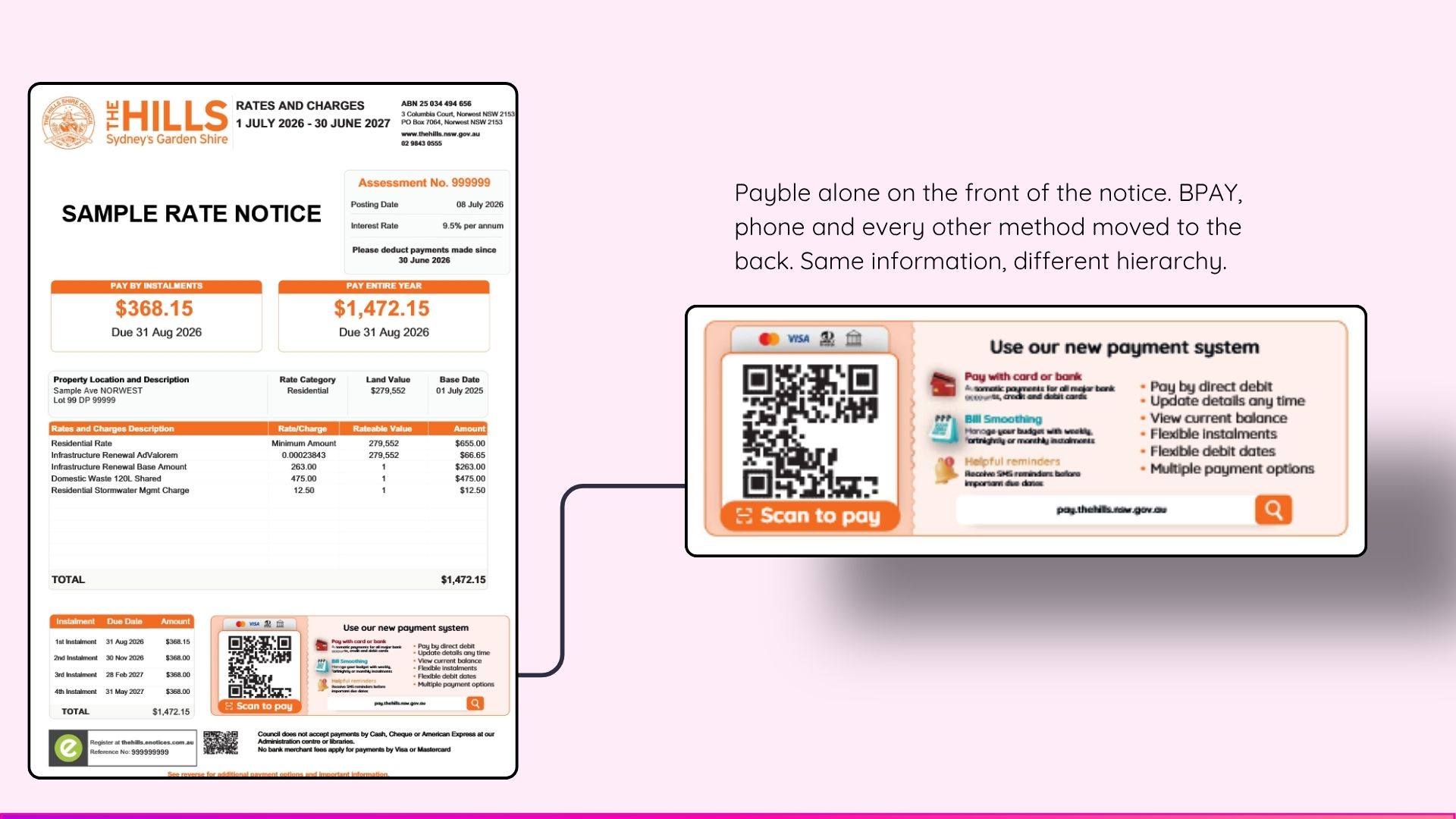
The Hills placed Payble as the clear primary payment option on the front of the rates notice, while retaining other payment methods on the reverse side. This gave ratepayers a more obvious next action and helped active payment plans more than triple in the first month.
The council then ensured that direct letters, printed flyers, website content, social posts, FAQs and in-person support all directed ratepayers to the same payment destination.
For senior leaders, this illustrates an important point: adoption improves when the service experience feels joined up rather than fragmented.
Scale without adding complexity
The long-term value of recurring digital payments is not only uptake. It is the ability for ratepayers to create and manage arrangements through self-service, reducing the need for manual intervention by council teams.
At The Hills, ratepayers could set up payment plans, adjust payment details and manage schedules through Payble, with changes reconciling to the council’s rating system.
The council also used staff training, a council-branded explainer video and ratepayer feedback to support a smoother transition.
The leadership takeaway
The Hills case study is a useful example of how a council can approach payment transformation as a service and operational improvement initiative, not merely as a new payment channel.
It demonstrates how clear choices in notice design, communications, staff readiness and continuous feedback can build ratepayer adoption while supporting a more scalable payment process.
👉 Download the full Hills Shire Council case study to explore the results, the rollout approach and seven practical actions your council can consider.
Ready to see what Payble can do for your council? [Talk to us today]